DELIBERATELY DIVERSE | Rev. Terry Pierce
Deliberately Diverse represents the opinions of some Taylor friends who never completely agree about anything but enjoy diverse discussions.
In the season of Epiphany, we are reminded that we who claim to be followers of Jesus are called to reflect the love of Christ to all people. We are called in God’s justice to accomplish God’s good purposes in the world.
How then does one respond in dark, conflicted times? Do we turn off the news and hope that all will be well? Do we march in the streets peacefully demanding a different future? Do we invest ourselves in partisan name-calling or do we look for common ground?
Some of these are hard questions that don’t have easy answers.
Barbara Butler Bass reminds us the good news of God’s love starts in the bad news of Christ’s crucifixion. All four gospels describe the witnesses to the crucifixion.
Luke’s gospel says, “But all his acquaintances, including the women who had followed him from Galilee, stood at a distance, watching these things.” (Luke 23:49) Says Bass, “Before there were any witnesses to the risen Christ, there were witnesses to Jesus mocked, tortured and murdered by the Roman empire. And that’s part of the Christian call of faithfulness — to stand in witness to the brutality, inhumanity, domination, sin and evil of the empires of this age. Because, before good news, the news can be very, very bad.”
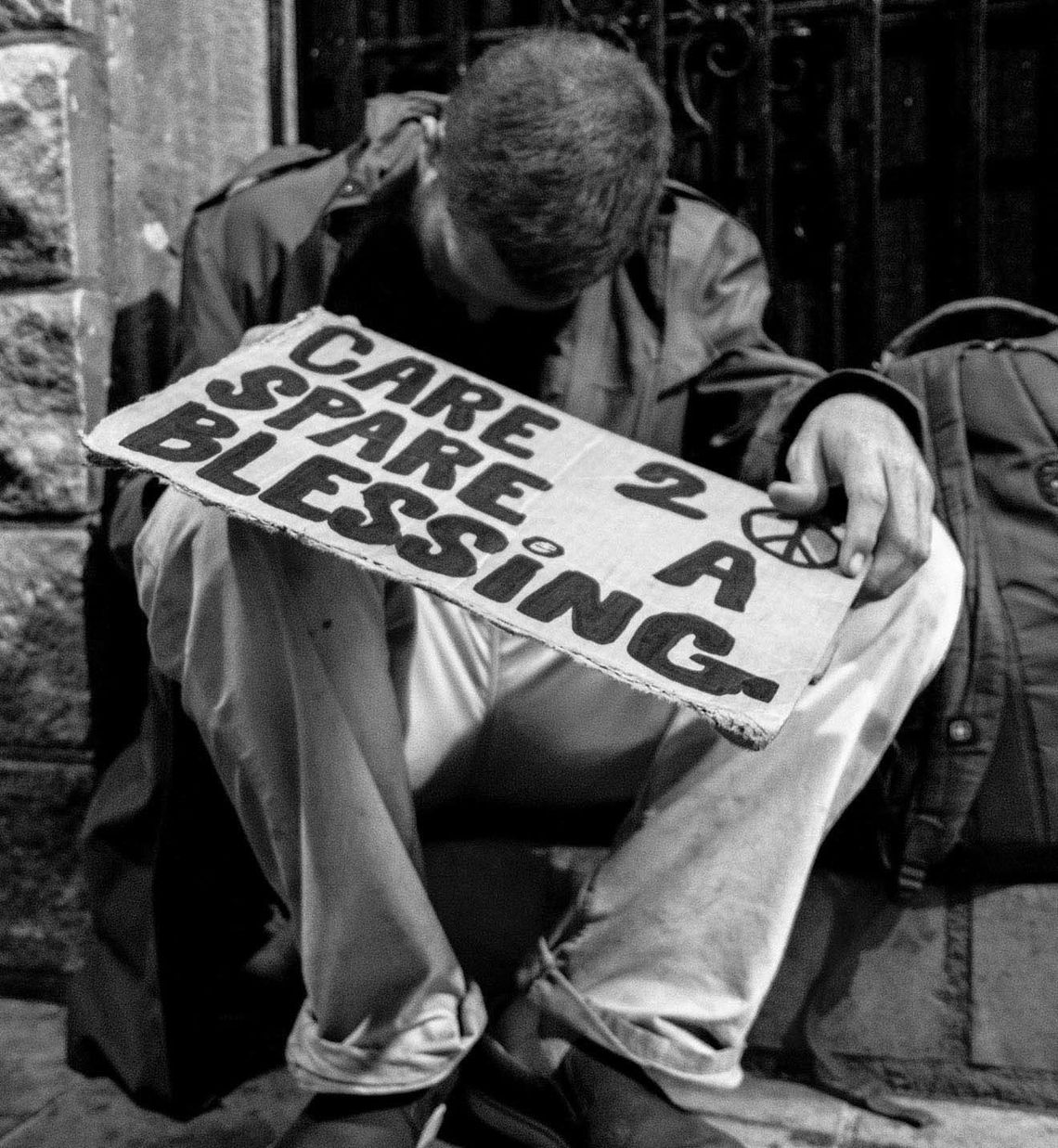
Some evening in the next two weeks, there will be a national Pointin- Time Count, or PIT, of unhoused people. It happens during a specific 24-hour period when volunteers go to the places where unhoused people may be staying and document their presence.
The purpose of the PIT Count is to provide a nationwide snapshot of homelessness, helping the U.S. Department of Housing and Urban Development and local organizations estimate population size, direct resources, track progress and make strategic decisions for funding and programs aimed at ending homelessness by counting both sheltered and unsheltered individuals on a single night.
This is a witness. It testifies to the existence and circumstances of people who are often invisible to us: People living in their cars, in unheated sheds or in the woods. Often these are people disabled by mental or physical illness or learning disabilities; people unable to function as part of the modern world for whom there are few alternatives.
This is written in the United States Holocaust Museum: “Thou shalt not be a victim. Thou shalt not be a perpetrator. Above all, thou shalt not be a bystander.”
How, then, do we stand in the love of God as witnesses? What is it to be more than a bystander?
Bass says, “Witnessing is active — it means bearing testimony (on) what one has seen, to provide evidence of the truth of a thing, no matter how shocking, brutal or inhumane. Witnesses tell a story … Witness. With words. With pictures. With your heart.”
The witnesses to the good news of God’s love watched and told what they saw.
Pierce is the vicar of St. James’ Episcopal Church in Taylor and can be reached by email at ministry@ stjamestaylor.org.