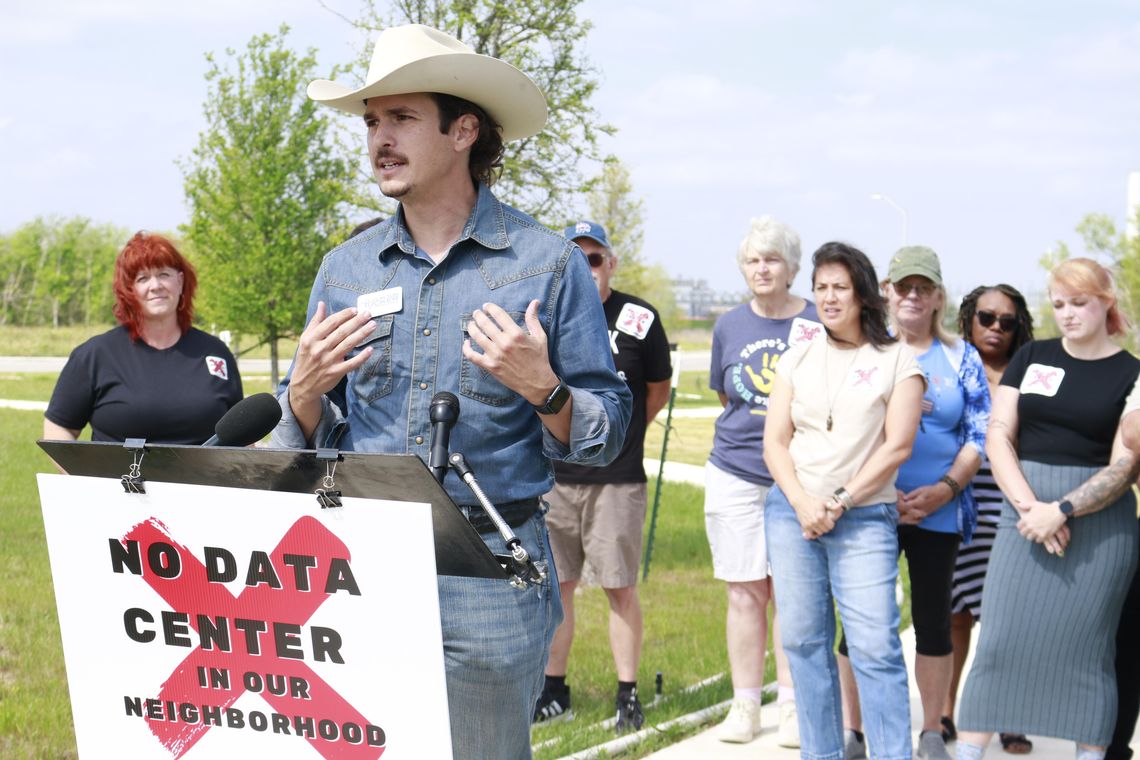
With three announced data centers planning to build in the Taylor area, the Halt Taylor Data Centers Coalition has ramped up efforts to let people know more about the industry and what they say are potential negative impacts to the community.
The group held a press conference Wednesday, March 25, at 210 Buttercup Road, a community park next to the site of a planned data center, and called for residents to attend the Thursday, March 26, City Council meeting and ask city leaders to hold off on approving zoning changes that would allow data center Project Comal to proceed.
Critics of the project want council members to wait until the city has had more time to revise its regulations governing local data-center developments.
The council meeting starts at 6 p.m. at Council Chambers in City Hall, 400 Porter St.
The movement highlighted by Wednesday’s gathering represents a wave of concerns both across the state and the country as the data center industry grows.
Clayton Tucker, who is the secretary of the Texas Farmers Union, said residents in states including Tennessee and Arkansas — some of the first sites for data-center development — are now having second thoughts about the tech facilities.
“Where they’ve built these things, power prices doubled. Where they’ve built these things, water wells started to run dry and the ones that didn’t became toxic. That could happen here,” Tucker said.
He noted that while developers may make promises about how they will operate, the industry has not been forthcoming with actual information on the amount of water or power usage.
“They have been lying to Americans all across our country about this issue,” he said. “The Texas Farmers Union is calling for a full moratorium on data centers in Texas until we can learn their true cost.”
TFU is a grassroots organization advocating on behalf of Texas farmers and has offices in Waco and Bastrop.
Proponents of data centers say the facilities are needed to keep up with demand for cloud computing and artificial intelligence. They argue the sites — often located in rural areas — generate local tax revenue that can be applied to capital projects, create construction and full-time tech jobs, and prompt local infrastructure upgrades.
While some worry water supplies could be harmed, data center developers say they often use closed-loop water systems.
Tucker said the office of the Texas agriculture commissioner can require an agricultural impact study to ensure data centers are being truthful in their claims and promises, which would provide additional assurances for Texas communities.
Critics also maintain data centers create a low-frequency vibration or hum that can be heard for a distance. However, these assertions are still being investigated to determine if there are harmful effects on health.
“Those waves travel more than five miles, particularly at night. So then everyone who has kids here might be at risk. Everyone in this neighborhood who’s over 65 may be at risk,” Tucker said.
Project Comal, if approved, would be located on 210 to 220 acres at 1051 CR 401 near Samsung Austin Semiconductor.
Another site, the $1 billion Blueprint Data Center also on Taylor’s south side and not far from Samsung, is looking at delays from legal hurdles posed by residents arguing the land was intended for a park and worried about harmful environmental outcomes. The 135,000-square foot facility has already been granted council approval and tax incentives.
A lawsuit filed by residents was dismissed in October by a state district judge but an appeal is underway.
Residents who are registered voters can sign a petition asking the council to create stronger data center regulations and request a yard sign from the “Stop the BPP Data Center” Facebook page, facebook.com/groups/804059889231784.
Data centers are also slated for Hutto and Georgetown.