Supporters hail program as 'out-of-the-box' thinking
HUTTO — An experimental program using duckweed filtration and greenhouses to make wastewater reusable could someday double the city’s water supply, officials said.
The City Council at its April 2 meeting got a look at a test program set for the city’s wastewater plant; it is designed to prove the technology’s effectiveness and increase water resources.
“Hutto has an opportunity to put ourselves on the map as the leading edge of technology. It’s just neat to see we’re getting out-of-the-box thinking. It’s an opportunity for Hutto to be a leader,” said Councilman Peter Gordon.
The pilot project will be privately funded. The city’s only responsibility will be to provide temporary use of a sliver of land and access to some wastewater, the council heard.
Water availability is a top priority for local governments as Williamson County’s population continues to grow by leaps and bounds. It’s not lost on officials that Hutto’s neighbor Pflugerville is experiencing a water-availability crisis.
Gordon has been meeting with developers and city staff since October to discuss specific details about the project and how the city could benefit. The technology was created by scientist Paul Skillicorn over decades of trials worldwide. The Austinbased Australian native has partnered with Lupine Development & Consulting of Hutto to implement the first test program.
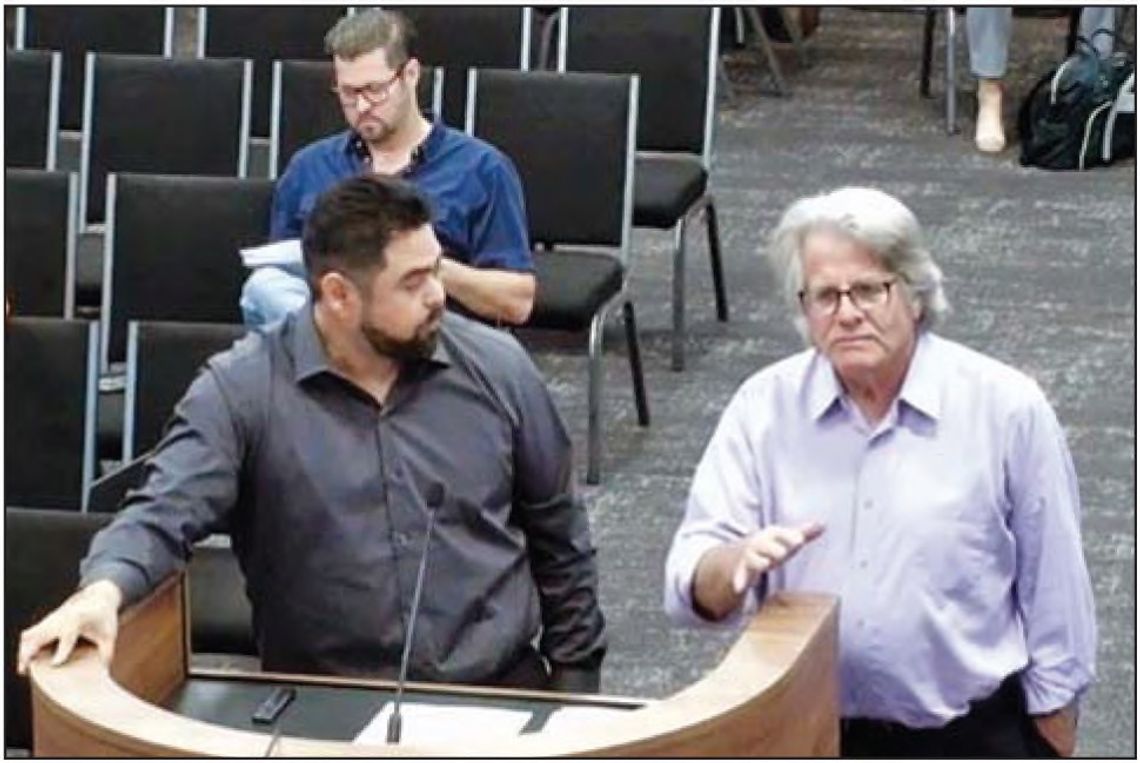
Michael Martinez, a Hutto resident and founder/CEO of Lupine Development, said the project is a recovery and reuse system that captures water the city is already releasing, treats it and puts it back to work.
If successful, it could virtually double the city’s water supply, officials said. While the water is potable, it would be applied to industrial and related uses, not for drinking.
“All capital is private. The city keeps full control. No public debt. No financial risk,” Martinez said. “If the pilot does not perform, everything goes back exactly the way it was at no cost to the city. We are not asking Hutto to bet on us. We are asking them to let us prove it.”
The project would be set up beside Hutto’s Central Wastewater Plant at 350 CR 199 and is designed to not affect plant operations, according to the developer. All data resulting from the experiment will belong to the city.
If all goes according to plan, Martinez said Hutto will become a case study for how a city can grow without exhausting its natural resources.
The developer said the system pulls nutrients from the water that create biomethane, which can be put into gas turbines to generate power and stabilize the city’s power grid.
What’s left from the waste can be used in agricultural fertilizers or products like bioplastics and engineered lumber.
“Because I live here, I kind of wanted to take ownership of this and, you know, do better for my city, especially as lots of industrial is coming through. I mean, we need something to try to stem the tide,” Martinez said.
Greenhouses and duckweed — the latter which can absorb heavy metals, ammonia and pollutants while providing nutrients for wildlife — are also part of the process, planners indicated.
Council members asked the developers to set aside money to restore the property in escrow to guarantee its availability when needed.
They also asked the company to pay the attorney fees for developing the contract between Lupine Development and the city.
City Hall staffers will now work with Lupine Development to create a contract to proceed with the pilot program.
Martinez and Skillicorn will showcase a solar antievaporation piece of the Hutto pilot program at the American Solar Energy Society’s Solar 26 national solar conference in Austin Oct. 19-21. For more, visit ases.org/conference.
“ “If the pilot does not perform, everything goes back exactly the way it was at no cost to the city.”
— Michael Martinez, founder/CEO of Lupine Development