License-plate readers, drones sought to stop catalytic converter thefts
Using license-plate readers and drones to catch crooks sparked some concerns at Mayor Jim Buzan’s first City Council meeting Thursday.
During the session, Police Chief Joseph Chacon sought and received approval to apply for an $81,428 grant from the Texas Department of Motor Vehicle Crime Prevention Authority to stymie catalytic converter thefts using surveillance technology.
However, community activist Carrie D’Anna sounded a word of caution about government tracking.
“I would like to see a lot more public assurance that those things are being treated with utmost respect,” D’Anna said. “I would like to see more concern around who gets to see that, how long that information is kept, how that is networked.”
Chacon said the Police Department has protocols to ensure safety, including being able to audit who has access to the records.
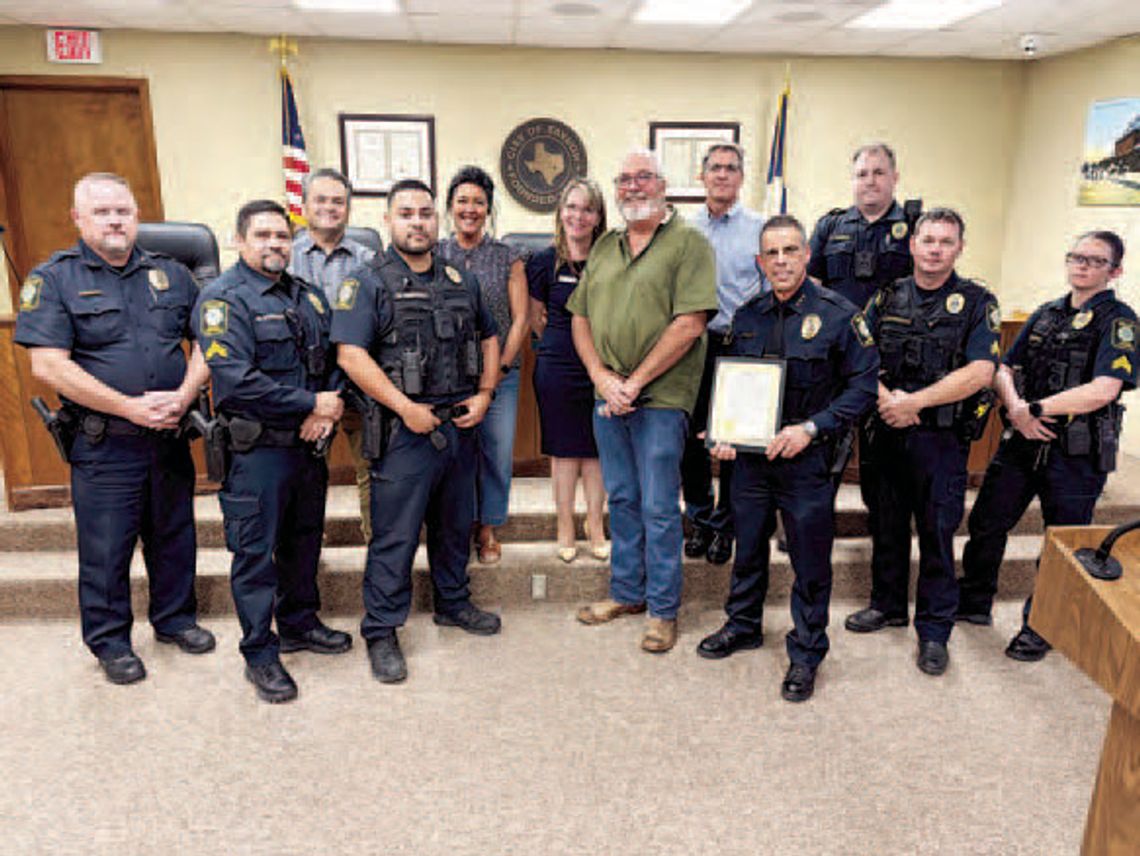
Buzan’s initial council session since his election May 2 also included a proclamation recognizing National Police Week, upgrading some streets and unveiling a statue at the Moody Museum.
Meanwhile, Chacon addressed the need for the state grant.
“The grant focus in recent years has been on the prevention of catalytic-converter theft. And it’s this aspect of the grant that Taylor PD will seek the grant funding,” Chacon said.
The grant would reimburse 80% of the cost, leaving $16,286 to come from city funds. The chief said he could cover that amount through savings from vacancies on the force.
If the grant is received, Chacon said funding would go to four items: a high-quality camera to document crime scenes, a drone, a mobile speed trailer that includes real-time license plate reading and activation of license-plate reading capabilities for all cameras already installed in Taylor patrol vehicles.
Most of the funds are earmarked for LPR technology. The chief said LPRs act as a “force multiplier” for the department when there are a limited number of officers on duty.
More investment for smoother roads
The council approved an additional $250,000 from the 2024 road-bond contingency fee to upgrade the paving on Second and Fourth streets. The lanes will now receive a thin overlay material topping to make them smoother, officials said.
Davis Street will see improvements from West Second to T.H. Johnson Drive. Davis had previously been approved for $2.7 million in maintenance from 2025 bond funding.
The council directed engineering firm HDR to add center striping on the road for the entire 1.9 miles. They also approved 3-foot shoulder striping on both sides of the street from West Sixth Street to T.H. Johnson.
Public Works Director Jim Gray said about $1.5 million remains from a $4.3 million 2019 certificate of obligation fund earmarked for transportation projects.
The city’s annual Level Up program, which is a program that grinds off a bit of the road surface and overlays it with a new surface, is funded by Taylor’s Transportation User Fee fund.
The average household in Taylor pays $8 per month to the TUF fund through city utility bills. The fee brings in $900,000 a year, which pays for a three-person crew plus materials to perform the leveling up, according to Gray.
Gray said his crew will complete 16,500 linear feet of road maintenance through the Level Up program this year.
Council members approved spending $1.5 million from the remaining 2019 funds to buy a new paving machine and increase the number of road miles repaired from 3.125 to 6.25.
“These are your worst streets in town,” Gray said. “We’re working at the very bottom of things and you can see the difference that it makes.”
Moody statue revealed Susan Komandosky, chairwoman of the Moody Museum Advisory Board, told council a new life-size bronze statue of Gov. Dan Moody will be unveiled 2 p.m. June 6 on the front lawn of the Moody Museum, 114 W. Ninth St.
The museum is the boyhood home of Moody, the youngest governor of Texas.
He was a native of Taylor who gained national fame for his legal victory over the Ku Klux Klan in the 1920s when he was district attorney of Williamson and Travis counties.