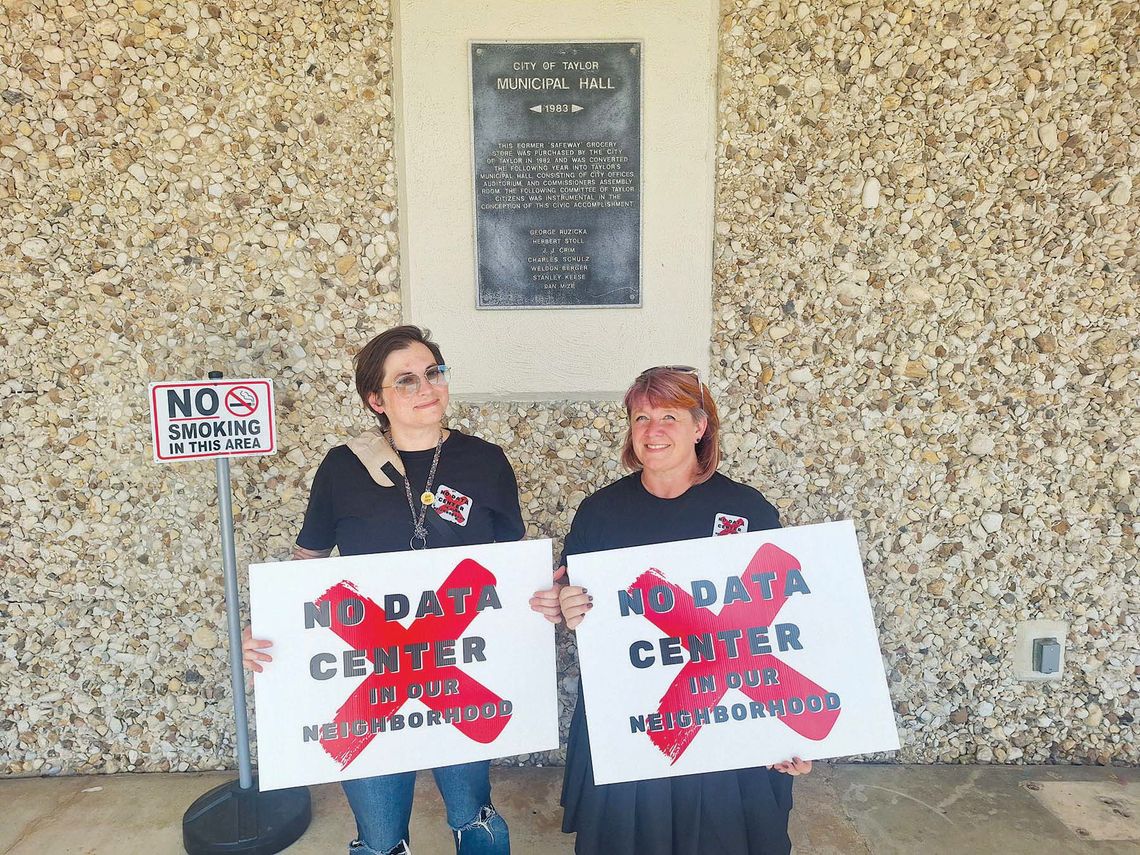
Residents ‘angry, disappointed’ it won’t be left up to voters
Taylor council members say despite a resident-led movement to put datacenter regulations before voters Nov. 3, state law ties their hands and means a push instead for a local ordinance subject to city approval.
Officials plan to allow public comment in July, followed by a City Council vote on a possible zoning change in September.
The reaction from many of those packing City Hall Thursday, July 9, to hear the council’s decision?
Anger and disappointment, with several indicating the council merely found a state loophole to prohibit rezoning based on a popular vote decided by the people.
A coalition known as HALT Taylor Data Centers a few weeks earlier presented the council with a petition containing 1,400 signatures asking the city to support tighter zoning controls on the development of data centers, including putting the matter to a vote in November.
The agenda item before the council last week was an ordinance to amend the city’s land development code to remove and prohibit data centers in all existing zoning districts.
“I’m angry,” Carrie D’Anna told council members while speaking during a public forum. “I know you told us before we started speaking to be civil, but I’m angry.”
D’Anna, who supported the amendment, helped found HALT Taylor Data Centers.
“HALT is a group of citizens that have come together to ask the city to create zoning regulations around data centers,” D’Anna said.
“We want to bring everything to a halt so we can have a conversation about what we need as Taylor continues to grow.”
D’Anna and members of her group are asking the city to put a pause on data center construction in Taylor.
According to a city release, the petition signatures were certified by Williamson County officials, but a consultation with “outside legal counsel” made clear state law “does not allow a city to enact or change its zoning by popular vote.”
Much of the public chagrin over data-center development sprang from plans proposed by the Blueprint Projects Data Center for Taylor’s South Side on land neighbors have argued was intended for a park.
City seeks cooperation
City leaders said they want to work with residents.
“We have heard the concerns raised by members of our community, and I want to be clear that this is a determination about the legal process available to the city, not a judgment on those concerns,” said Mayor Pro Tem Kelly Cmerek. “Texas law does not allow zoning to be enacted or changed by popular vote, so the council cannot place this measure on the ballot. But the concerns behind the petition are exactly what we are working to address through our Comprehensive Plan and Land Development Code.”
Cmerek urged those who “invested time and energy” in the petition drive “to stay involved as we develop these new regulations.”
The council member added, “The input we have received is shaping how we protect our neighborhoods, and we want that work to continue.”
Prior to the start of the meeting, D’Anna expressed concerns about data centers in general.
“The main concern is how data centers affect people and land,” she said. “The scale and speed in which they are moving into neighborhoods in the city are quite alarming. We’re looking for land and human centered zoning. We want a guideline and structure around these decisions.”
According to elected officials, Taylor is looking at amending its Comprehensive Plan and Land Development Code and wants to address not only data centers but all digital infrastructure.
The proposed amendments would create new requirements for such uses, including environmental protection, performance and compatibility measures to protect neighborhoods, noise mitigation, air quality and water conservation.
The draft regulations are now available on the city’s website for public feedback and comment at https:// fni.mysocialpinpoint.com/ taylor- comprehensive- planand- ldc.
Public comments will be accepted through July. Taylor anticipates an ordinance coming before the council in September for approval, following the public input and required notifications.
Pros and cons
Critics of data centers say they worry about noise, water consumption and drains on the electrical grid from a data center. Proponents note data centers are needed for artificial intelligence, banking, communications, and military and national security.
Supporters also say while data centers do not employ a large workforce, they create temporary construction jobs and pump millions in tax revenue into schools, hospitals and other entities, In another matter regarding data centers, Gov. Greg Abbott called for a ban on data centers in rural neighborhoods June 30.
Abbott also called for the Public Utility Commission of Texas and the Electric Reliability Council of Texas to take action to ensure data centers lower residents’ energy bills and foot their own bill for electric infrastructure.
Data center advocates note many facilities are using water-conserving closed loop systems and building their own power plants, while also giving the U.S. parity against foreign enemies in the race to control the digital frontier.
“
“We want to bring everything to a halt so we can have a conversation about what we need as Taylor continues to grow.”
— Carrie D’Anna, HALT Taylor Data Centers