Clean water, disannexation and a P&Z clash
EDIE ZUVANICH Special to the Press
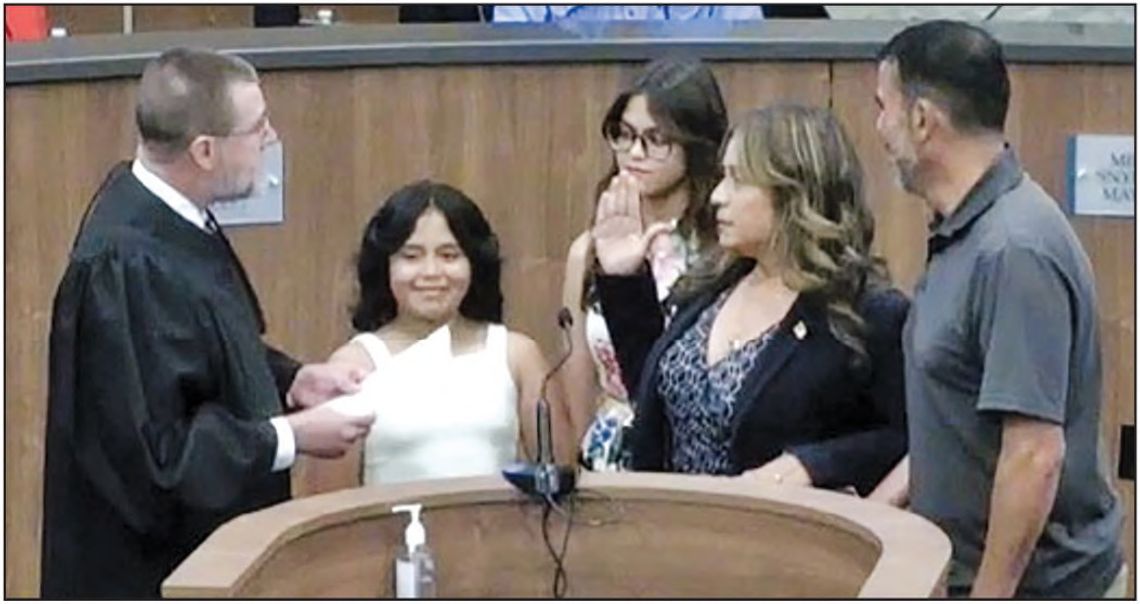
HUTTO — The City Council has welcomed its newest member, Corina Zepeda.
She won the May 2 election to replace long-serving Councilman Peter Gordon, who had reached his term limits and was not eligible to run again.
The Place 1 council seat is - still held by Charles Warner
pending the runoff election June 13 between Jerrel Reynolds and Brandy McCool.
In other business during the May 21 session, the leaders on the dais released properties from annexation and pushed for cleaner water. Mayor Mike Snyder also took a member of the Planning & Zoning Commission to task.
Disannexations approved Following state law, the city “disannexed” two properties, reversing its stance on release requests regarding the parcels that were previously denied.
Senate Bill 2038 allows property owners to request release of their properties from annexation into a city’s extraterritorial jurisdiction.
Earlier this year, owners of 420 and 460 Hyview Lane petitioned to be removed from the ETJ, but those requests were turned down.
However, Hutto officials recently determined the municipality could not provide wastewater service to the properties within the statutory timelines required if the properties changed to commercial.
The city has agreed to conditionally disannex the properties.
The proposed release agreements would mirror stipulations approved for 400 Hyview Lane in 2025.
The owners agreed to not create a wastewater treatment plant on the property and to only use a wastewater service provided by a governmental entity. The contract also includes provisions preserving Hutto’s ETJ authority and limited-purpose annexation rights for future commercial activity.
Stronger measures for clean water The city updated its industrial waste discharge ordinance by giving the Public Works Department more power to enforce discharge rules, including the right to enter private property to investigate suspected wastewater violations.
David Thomason, public works utility manager, said the city has identified and contacted a dozen industries with the potential of discharging into the collection system.
Thomason said the department will monitor releases into the water system.
“We will go out and do spot checks, collecting samples at any time. Also doing random inspections of their facility to see environmentally how are they taking care of what the waste is. A lot of them we found actually haul their waste off to other places,” Thomason said.
Businesses violating the ordinance must pay all costs for testing and mitigation, officials said.
Thomason said federal agencies could become involved if waste makes its way into streams, triggering even greater fines.
“The purpose of this ordinance is to put the onus on the industry. It issues permits to the industry requiring that they install pre-treatment equipment, treat their wastewater prior to it going to the city sewer so that they’re pulling pollutants out before it gets to the city’s wastewater treatment plant,” said Troy Zwerneman with Brazos River Authority.
BRA worked with the city to develop the updated ordinance and enforcement guide.
P & Z Commission chair reproached A fracas between Mayor Mike Snyder and Rick Hudson, chairman of the P&Z, was put on the back burner pending whether a formal complaint is filed that could lead to Hudson’s removal.
The controversy stems from a call made to Hudson by an applicant after the P&Z denied his petition, Hudson said. The chairman said he then offered an opinion the council might not support the applicant.
According to Snyder, the applicant called him after the conversation with Hudson and relayed concerns about what Hudson said.
Hudson stressed that he spoke as a private citizen and what he told the applicant was only his opinion and not legal advice.
The council debated whether the situation called for Hudson’s dismissal or was an opportunity for more training.
“If I have lost the trust of the council to perform my duties, then I should not be on that board,” Hudson said. “Allowing me to continue where I still have that access would be an exceptionally stupid idea.”
After deliberating in executive session, no action was taken because a formal complaint against Hudson had not been submitted to the city.
“ “We will go out and do spot checks, collecting samples at any time.”
— David Thomason, public works utility manager