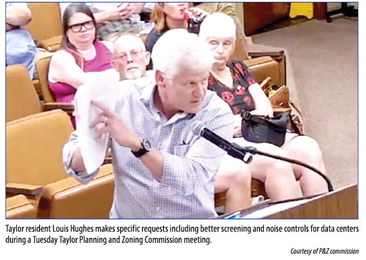
P&Z recommendations still need City Council approval
No new data centers will be permitted within city limits if the City Council approves amendments to the Land Development Code recommended this past week by the Planning and Zoning Commission.
The amendment would require digital infrastructure development – data centers, bitcoin mining operations, power plants, battery storage facilities and others – to be at least three miles apart.
The location of existing projects overlap in a way that does not leave three miles of separation available for any other sites to develop within the city.
The 3-mile recommendation is part of the city’s Phase 1B Land Development Code rewrite currently underway. The section that will govern digital infrastructure is a new addition to the code.
On Oct. 13, the Taylor Planning and Zoning Commission heard a presentation on the recommendations and held a public hearing before ultimately passing a recommendation to present to the council at a future meeting.
“This isn’t something that was put together in a week to paper something over. This was an exhaustive process that we’ve gone through,” said David Jones, project manager with consultants Freese and Nichols. “These were things we could go in and fix and look at without breaking other sections of the code. The LDC is an intricate document and all the different sections have to work in harmony together.”
The Phase 1B amendments are intended to be put into use quickly so the city can get regulations on the books, then be refined during Phase 2.
Phase 2 will be an entire rewrite of the LDC.
Several residents spoke out during the public hearing for the digital infrastructure codes, including Louis Hughes, who shares a fence line with the proposed Project Meridian data center.
Hughes specifically asked the commission to make the noise level 45 dBA maximum — a unit of measurement for acceptable human-hearing levels — around the clock instead of only during the evening, to add wording protecting residential properties even if they are not in a residential zone, and to establish a 12-foot screening berm around facility property instead of a 4-foot berm.
Commissioners agreed to include each of these suggestions into the recommended amendment, as well as establishing a 1,000foot setback of facility buildings from all property lines instead of just those shared with residential properties.
The development standards would also require a minimum site area of 100 acres and a maximum height of three stories or 60 feet, with a step-up allowance to 120 feet beyond the setback.
Water usage, air quality and monitoring are included among the suggested codes for digital infrastructure usage.
Taylor, working with Freese and Nichols, is updating both the Envision Taylor Comprehensive Plan and the Land Development Code. The process has continued since October 2025.
Information about the code rewrite and the digital infrastructure regulations can be found at fni.mysocialpinpoint. com/taylor-comprehensive- plan-and-ldc.