OUR TOWN
Have you ever wondered how the Taylor City Cemetery began? Was there an immediate need such as an accident, a murder or an epidemic? Maybe Williamson County’s newest community was simply being proactive in planning for the future.
While searching for the answer, I discovered some interesting facts about the property on East U.S. 79 that has become the final resting place for many local families. I also found some fascinating stories about some of the people buried there.
First, the interesting facts. According to the city of Taylor website, taylortx. gov/266/Cemetery, shortly after the founding of Taylorsville (now Taylor) in 1876, the city cemetery was established. The first graveyard land was acquired in 1889 after being sold to the city of Taylor by John Barues and Jacob S. Whitmore.
That original 30 acres is now referred to as the “1st addition.” There have since been three more additions and a fifth addition is available for development.

Today, the final resting place for so many in Taylor occupies over 140 acres of rolling hillside on the east side of town.
While those facts preserved in city and county records are very interesting, they don’t tell the full story. So, I decided to dig a little deeper and looked for first-hand accounts from people who were living in Taylor at the time.
My next stop was the Duck Room Museum on the old Northside Elementary School campus at North and Dellinger drives. This amazing local treasure is home to over 140 years of history of Taylor schools. Maintained by the Taylor High School Ex-Students Association, the archives include Taylor High School’s very first yearbook from 1916.
In those pages, and just 34 years after the founding, student reporters included the following history of their town’s early beginnings: “It has been said that you have to kill a man to start a cemetery, and this was true of our cemetery; for Mr. McDonald, who was shot and killed, was the first man to be buried in the city cemetery,” according to the account.
Now we have a name and cause of death for the first person to be laid to rest in our local burial ground. But was he murdered, or did he die in self-defense? Maybe it was an accident?
There were still questions to be answered.
During another visit to the Duck Room, I was researching a totally different topic when I stumbled across a 1940 interview with Mrs. John S. (Martha) Kritser in the school newspaper, The Cotton Boll.
She was born in 1858 and lived in the area her entire life.
If you read my previous “Our Town” column about the fire that destroyed much of downtown Taylor in 1879, it was Mrs. Kritser’s account of the fires and the recovery afterward that I quoted. In that same interview, she also provided the following information about the shooting that prompted Taylor to start a cemetery.
“The railroads were established in 1876, bringing with them many undesirable characters. There was very little order and discipline at that time, and a gang of desperados under the leadership of McDonald ruled the town.
“It was a habit of McDonald to ride down Main Street brandishing his pistol and shooting in the air demanding that the storekeepers close their stores. Naturally, when anyone saw him coming, they would give an alarm and run for cover. But one day a young fruit-stand keeper refused to close up, so McDonald began throwing apples at him.
“The boy with great calmness and accuracy picked up a gun typical of the Civil War days, drew a bead on him and shot him. It has been said that McDonald was the first white man to be buried in the Taylor Cemetery.”
Later, I came across an article in the centennial edition of The Taylor Daily Press that also called McDonald a desperado, a black-bearded fellow who ruled the town for almost 15 years. The article also said on this sunny morning, McDonald rode down the street “yelling in his usual manner that the stores be closed, prancing his horse and shooting into the air.”
When the young fruitstand keeper refused to close his doors, “McDonald rode past the stand, grabbed a sack of apples and chunked them one at a time at the young keeper.”
The boy was not intimidated and shot McDonald through the heart.
“McDonald was the first white man to die in Taylorsville and the town had to begin a cemetery and so the desperado became the first person buried in the Taylor City Cemetery.”
When I checked the city’s roster of names of those buried in the local cemetery, J. McDonald is listed as “First person to be buried in the Taylor City Cemetery,” but there is no date of death and no section, lot or block number given for the location of his grave. After a near-15 year reign of terror, it seems the people of Taylor were glad he was gone and never put any kind of marker on his grave.
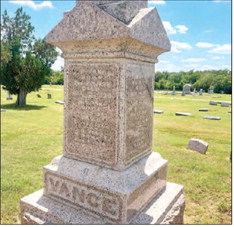
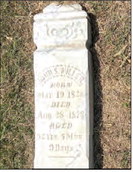
The property that became the Taylor City Cemetery must have been used for burials prior to McDonald’s death. The city website reports the oldest burial site is that of the Vance family, which dates back to 1853. The oldest legible stone marker found on the site is that of John S. Miller who died in 1878. The website also reports the grounds include a historic African American section as well.
As radio host Paul Harvey used to say, “And now you know the rest of the story.”
Join me here in a couple of weeks as we take a look at another one of Taylor’s fascinating stories from the archives.
Until then, be proud of where you’re from.
Crow is a longtime Taylor resident and retired from the Taylor Independent School District after 40 years of service. For a topic or suggestion, reach out to Crow via emily.treadway@ taylorpress.net.