OUR TOWN
If I could travel back in time to witness any of the numerous significant events in Taylor’s history, the 1910 paving of First Street with wooden bricks would be at the top of my list.
I’ve known for quite some time that pinewood pavers were hidden under the pavement in front of the old Blazilmar Hotel, and I have stopped on several occasions to look through holes in the pavement where I could see small glimpses of the wooden bricks underneath.
Now, in conjunction with Taylor’s 150th birthday celebration, and the arrival of the “Spark! Places of Innovation” traveling Smithsonian exhibit, the city of Taylor has removed a large section of First Street pavement, leaving the wooden pavers totally exposed for anyone who would like to stop by the spot where the city began and take a closer look at this part of our history.
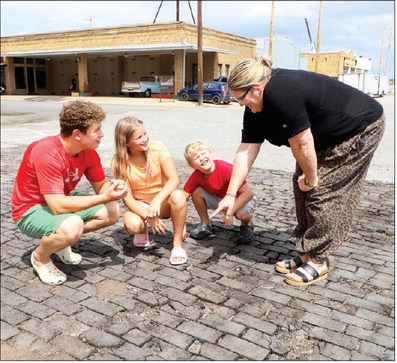
Local historian and Realtor, Emily Downs Smith (far right), gives a guided tour of the wooden bricks paving First Street in Taylor. From left are Wade Stroud, Annie Stroud, Ryder Stroud and Smith. Photo by Tim Crow

You can even reach down and touch the still visible rings from when these bricks were pine trees and imagine what life might have been like for the people who walked across this unique street when it was new, or rode in horse-drawn carriages across these exact same bricks.
I wanted to learn more about this unique part of our history, so I contacted local historian and Realtor, Emily Downs Smith, to learn more about the topic from her many hours of research.
As a retired educator, I also wanted to include some of Taylor’s youth in this project to learn more about their local history. Three members of the Stroud family accepted my invitation: Wade, 13, Annie, 10, and Ryder, 8. You may have seen their family, including parents Warren and Ashley, and younger siblings Ember and Colton, in several fun and creative social-media commercials for their family business, Plumbing Outfitters.
Wade, Annie and Ryder joined me in Emily’s office for the interview, and then we all went down to First Street to examine the unique pavers close-up.
Wade asked the first question: “How big were the wooden bricks?”
“The wooden pavers were 4 inches deep by about 10 or 12 inches long,” Emily explained. “It’s basically a chunk of railroad tie that was treated with tar to keep out the moisture.”
The paving was done by The Kaw Paving Company. The general office was in Topeka, Kansas, but the southern office was located right here in Taylor.
“They did a layer of gravel, and then a layer of sand, and then they laid the pavers down,” Emily said. “The pavers would go down in one direction in the center of the street and on the borders they would go a different direction. They were horizontal on the street and vertical along the curbs.”
Another layer of sand would fill in the cracks between the bricks, and then a final layer of tar was poured over the top.
In an advertisement from the 1916 Taylor High School Yearbook, The Kaw Paving Company informed the community it constructed “asphaltic, concrete, brick and other forms of street paving.”
The firm also claimed, “Good streets and sidewalks are town builders and essential to community progress.”
Emily’s interest in local history has proven to be a benefit as she works with clients in real estate.
“Because we work with a lot of downtown business owners and downtown building owners, one of the things we like to do with all of our incoming businesses owners is to (introduce them to) the rich history we have here in Taylor,” Emily said. “When someone buys a property, we want them to know how amazing it is and the deep roots and the history that the home or the building or the property holds. We want them to carry that love and reverence with them.”
While Emily hasn’t found the exact measurements for the length of the wooden brick section of First Street, it likely ran from close to Elliott Street to Main Street. That distance would have provided pavement for the high-traffic area in front of the train station and the Murphy Hotel, which later became the Blazilmar Hotel.
A quick look at city directories from the time indicates the 100 block of East First Street also included a barber shop, a cigar and liquor store, a tailor shop and a saloon.
Emily has also found where property owners paid for the paving. Taylor’s original dirt streets were known to be dusty, and often a muddy mess. So, it seems that paving would have provided a significant benefit to businesses.
“I found a receipt for a payment from T. W. Marse for 270 feet which is from corner to corner, the entire block from Porter to Main Street,” Emily said. “It likely went down to Elliott Street, closer to the Heidenheimer building.”
The Heidenheimer building, 209 E. First St., is the location of the free “Spark!” exhibit, which runs through Sept. 27.
Our young historians asked excellent questions during the interview. In addition to the size of the bricks, Wade wanted to know how many people lived in Taylor at the time, and if they used chainsaws to cut the wooden bricks.
Ryder asked if they had axes back then, and how many bricks were used.
According to the 1910 Taylor city directory, the population at the time was 6,612. Emily explained they would have used handsaws to cut the pine wood into bricks, and measurements were probably taken in square yards rather than by the number of bricks.
The young historians also asked about the Kamp Hotel, and the fire of 1879 that destroyed much of downtown Taylor. Annie wanted to know what happened to the homes and farms when Lake Granger was built. Wade also asked if people in Taylor’s early days settled their differences in the way you might see in old western movies and TV shows.
That last question brought to mind my column from Aug. 16 about how the Taylor City Cemetery began. If you missed it, check it out in the Taylor Press archives at taylorpress. net.
I must say, it warms this old Duck’s heart to see the younger generation taking such an interest in their hometown history. I believe every family in Taylor would enjoy a visit to see the wooden bricks, and the “Spark!” showcase while it is still in Taylor.
Join me here in a couple of weeks as we explore another tale from Taylor. Until then, be proud of where you’re from.
Crow is a longtime Taylor resident and retired from the Taylor Independent School District after 40 years of service. For a topic or a suggestion, reach out to Crow via emily.treadway@ granitemediapartners. com.